Don't Keep Up. Keep Out.
The Hidden Cost of Consuming Everything
What does information consume? The answer is both obvious and startling: attention.
The economist Herbert Simon saw this coming in 1971: "a wealth of information creates a poverty of attention." I encountered the idea decades later in ChrisHayes' book The Sirens' Call, where he sharpens it:
“the information age must also be the attention age."¹
Next question: when we reflect at the end of a day, a month, a year, or a lifetime, what is it we are reflecting upon? The answer, again, is both obvious and startling: where we dedicated our attention. Our memories are made of nothing else. We don't think of it this way, but our attention is how we experience life.
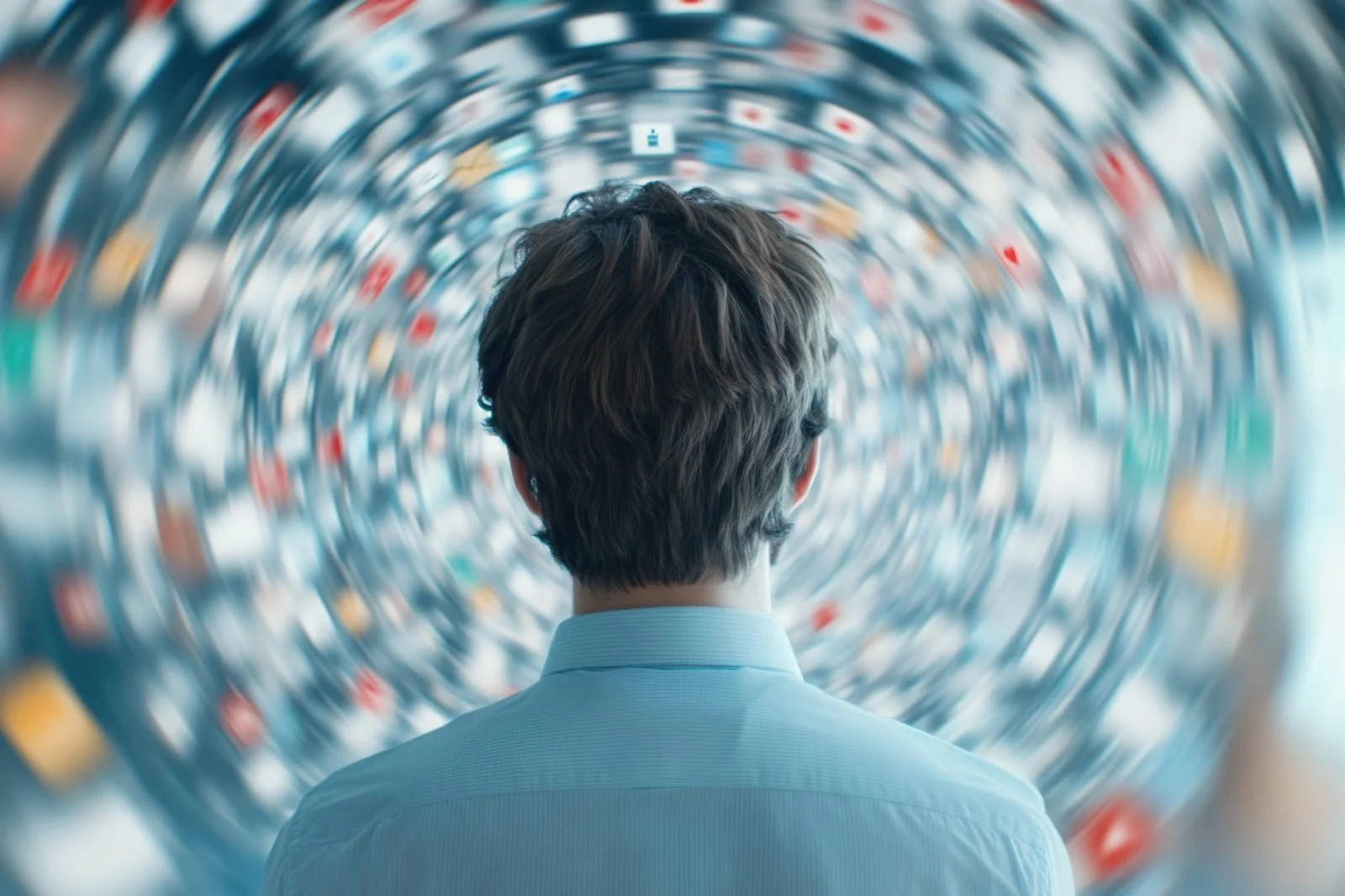
Hayes argues that in this age of digital everything, information is infinite. If this is true—and few would argue otherwise—then what becomes infinitely limited, and thus infinitely valuable, is attention. Our attention. It is the means by which we engage with life.
The paradox of our time is this: the flood of information, the pace of change, and the constant disruption leave us feeling like we need to keep up—to stay perpetually plugged in and informed. But the reality is we don't need to keep up. We need to keep out. We need to keep out what does not serve us. We need to guard our attention as if it were our most valuable resource—because it is.
To borrow from a recent movie title: if everything is coming at us, from everywhere, all at once, power lies not in consumption but in subtraction. Steve Jobs put it plainly: "Focusing is about saying no."² So is reclaiming our thoughts. So is reclaiming our lives.
Another question: what do you believe? That's likely an easy one—you can probably answer without much difficulty. The next question will require more thought: why do you believe what you believe?
The answer is complicated, because what we believe is made of the totality of our lived experience—our upbringing, the friends we keep, our culture, and life events, both good and difficult. And increasingly, our social media feeds. Those channelized, algorithmically managed echo chambers that soothe our minds in a world so complex and disrupted it is often hard to comprehend—feeds that offer both reassurance and validation.
And increasingly their design captures our time and attention. Consider the impact: the average adult spends nearly seven hours a day on screens—approximately 25 percent of that time on social media alone. If attention is life experience, that's a significant share of our lives.
Earl Nightingale, often referred to as the Dean of Personal Development, famously observed, "We become what we think about."³ If Nightingale is right, an obvious set of questions follows: What do we think about all day? And are those thoughts aligned with who we want to become, the world we want to live in, and the future we hope to create? Upon candid introspection, I suspect most of us would answer no.
Don't mistake my words for a call to disengage—to retreat or bury our heads in the sand. It's not. Discernment is not apathy or deflection. It's self-discipline. It's control.
There's a saying used to describe someone with great depth of knowledge in one area but little understanding beyond that narrow scope: they are an inch wide and a mile deep. Without self-awareness, we run the opposite risk—becoming an inch wide and an inch deep. Poorly informed in every direction. Certain about everything. Curious about nothing.
This isn't theoretical. And I suspect we've all seen this. I remember a day when my wife was scrolling through Facebook and came across a post that drove this point home. An old friend had shared a political meme that was clearly false. She commented, "You know this isn't true, right?" His response was brief and revealing: "I don't care—I like it." The information wasn't right. It just felt good.
Bottom line: we are each responsible for how we manage our attention. Where we focus determines who we become, the lives we live, and the future we construct. It is not easy. But it is our responsibility. Mine. Yours. Every day.
The Seeker's Mindset: Question what you're fed. Choose what you let in. The life you're paying attention to is the only one you live.
Notes:
¹ Hayes, Chris. The Sirens' Call: How Attention Became the World's Most Endangered Resource (p. 164).
² Steve Jobs put it plainly at Apple's 1997 developer conference: "Focusing is about saying no."
³ Earl Nightingale, The Strangest Secret (Herndon, VA: BN Publishing, 2006) 28.