Trust the lesson. Question the flinch.
When experience teaches the right lesson but
the wrong reflex.
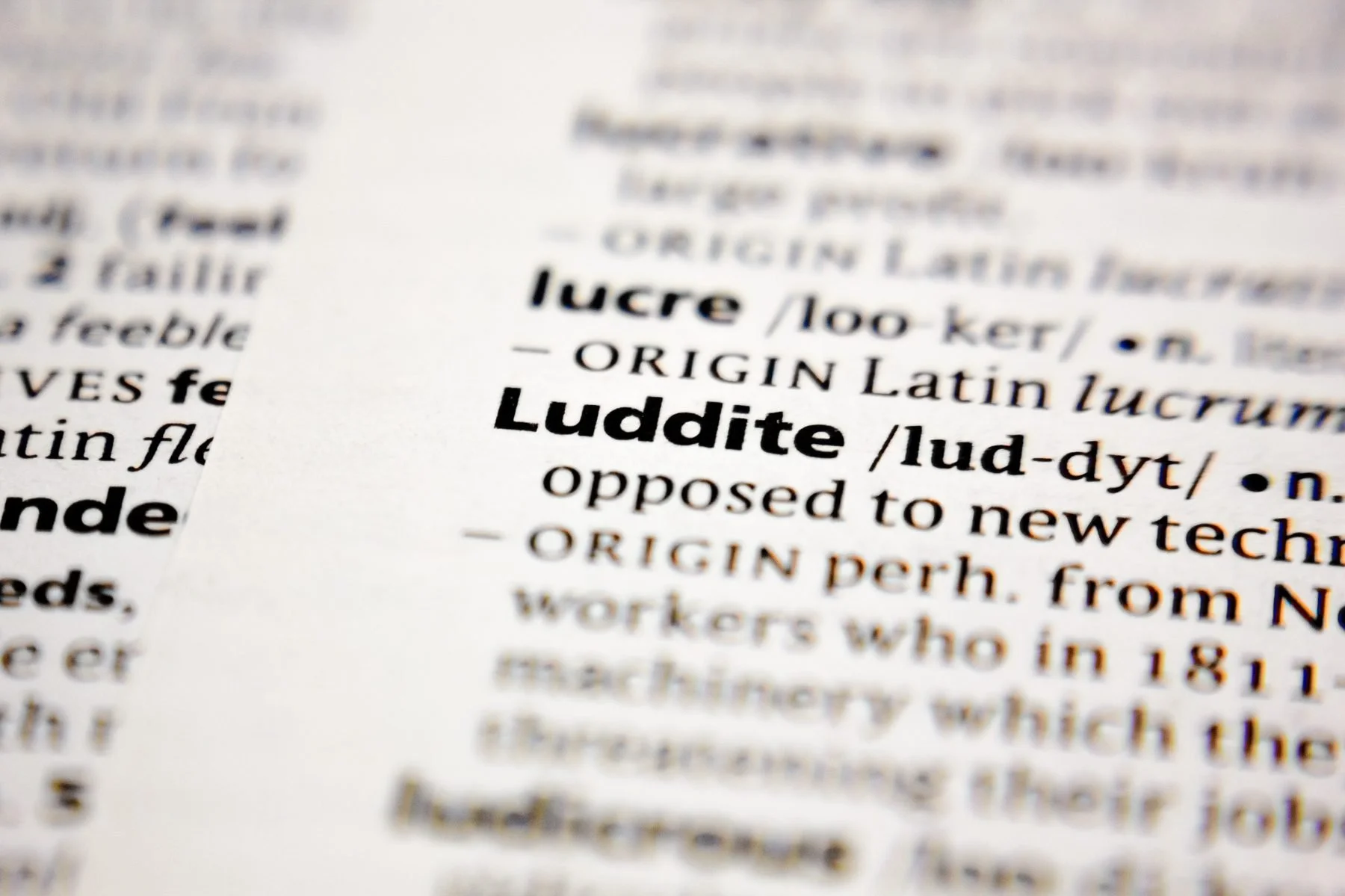
My wife is a bit of a luddite—that is not an insult, she freely embraces the term. She is a brilliant and very capable woman who has scaled many technical learning curves over the years. And, as counterintuitive as it may seem, in today's world of endless technical peaks, that experience can be a disadvantage.
Here's what I mean. In 1999, when we decided to start our own company, I told her it needed to have a website. At the time—and I know for some this is hard to imagine—websites were relatively new. Justifiably, she did not understand why a website was important. After all, there were just two of us working from a spare room in our house. Why would we need a presence on the World Wide Web, as it was known back then?
Finally, mainly because I would not shut up about it (I can be like that), we went to the bookstore and bought a book on how to build a website (CD included). The next day she cracked open the book, and two days later the company's first, very rudimentary website was live online.
Years later, when we decided to implement Salesforce, we hired a consultant to manage the project. Unfortunately, the consultant's marketing capabilities exceeded his technical prowess, and the project was left on the verge of collapse. In response, and determined to salvage the project, she dove into online tutorials, learned how to code for Salesforce, and rescued it. For the years that followed, she was not only the company CFO but its Salesforce guru. I could share more stories like these, but you get the point.
So how, you may be wondering, could this possibly be a disadvantage?
Because the experience is both intellectual and emotional—technical and human.
Past projects had been difficult, time-consuming, and above all, stressful. And while her efforts were hugely successful and admired, the personal fun-to-misery ratio landed on the wrong side of satisfaction.
Fast forward 27 years. We sold our company three years ago, and I have completed writing my first book, Seeker's Mindset. After careful consideration, we made the joint decision to publish it independently, and the past echoed when I said... it needs a website. Do you want to build it?
I watched the blood drain out of her face as memories of her past experience came into sharp conflict with her naturally supportive nature. Eventually, the supportive angel on one shoulder overcame the devil of her past experience making itself known on the other, and she said yes—with the enthusiasm of someone volunteering for unpleasant and, at times, painful duty.
Four days after beginning the work, she launched www.seekersmindset.com. We were both thrilled with the final product and the speed at which it had been completed. That evening an unexpected thing happened. As we were reviewing the day and the project, she said, "I'm looking forward to doing the next site" (we have an associated site planned). She continued with a smile, "When I first sat down to work on the site I was dreading it. But it was enjoyable.”
So, what changed?
Technology—its capabilities and sophistication. First, she used AI to quickly define the hosting solution that best fit the project's requirements; in this case it was Squarespace. Then, leveraging the design tools the platform offers in combination with AI's ability to shortcut the figure-it-out process, she found the struggle she anticipated did not materialize. Don't get me wrong—the process still required commitment and effort. It's just that the tools the platform provided, combined with the technical assist from AI, allowed her to focus on the creative aspects of the work, which she enjoyed, rather than having to hunt and peck through videos, user guides, and online forums as she had done in the past.
What we both realized that evening is that during periods of unrelenting and accelerating change, the experiential knowledge we acquire can be a tremendous asset when navigating the path ahead—but the emotional reflex associated with that past experience may no longer apply.
Perhaps the lesson of a Seeker's Mindset comes down to this: Trust the lesson. Question the flinch.