The Pragdealist
Pragdealist noun \ˌprag-ˈdē-ləst\
Definition: A person who is practical in approach and idealistic in pursuit; one who pursues meaningful goals through disciplined, realistic action while striving toward higher purpose or aspirational outcomes.
A Pragdealist meets the tides of change with sights set on the horizon of greater possibility.
I once heard a compelling idea that each of us answers one fundamental question throughout our lifetime—a question that then informs and biases every decision that follows: Is the world inherently good and in my favor, or inherently bad and against me?
How would you answer? What horizon would call to you if the weight of past disappointment or fear of comparison, criticism, and failure held no sway and could never scuttle your dreams?
At a dinner party years back, the topic of life philosophy came up, and one of the guests turned to me and said: "So Rick, what's your life philosophy?" I answered—without hesitation—"Pragmatic Idealism"—what I now call Pragdealism. It wasn't a phrase I had ever used before, and I had no polished definition, just an instinct that it fit.
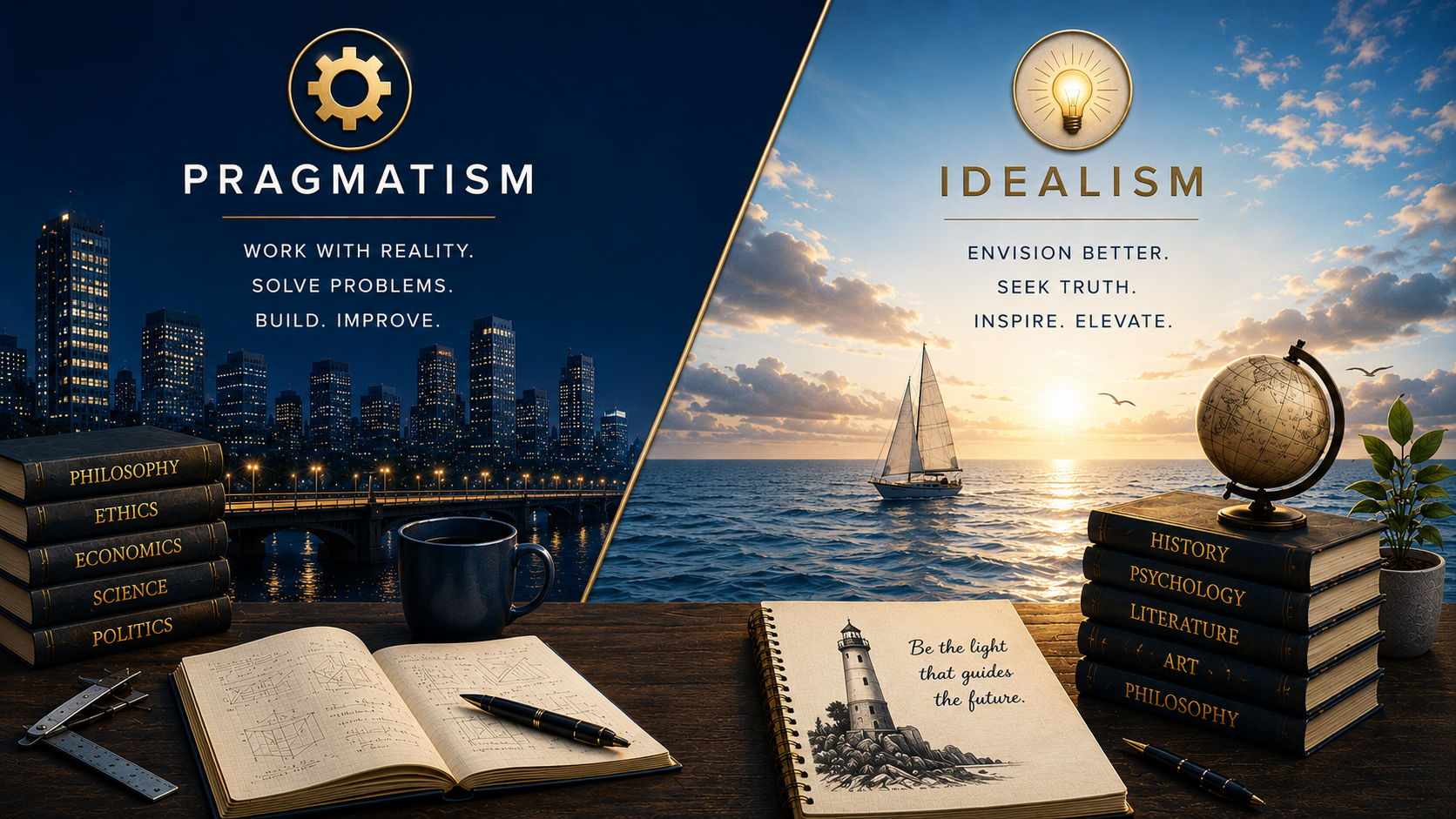
Over time, and after a great deal of reflection, I've come to better understand what I meant. Pragmatism emphasizes what works—utility and functional outcomes. On its own, however, it keeps us tethered to what is immediate and efficient—it risks shrinking our vision to maintenance and survival. Idealism, by contrast, emphasizes what could be—values, meaning, and aspirational possibilities that extend beyond immediate constraints. On its own, it lifts our gaze to distant horizons, but in isolation, risks leaving us rudderless in daily life.
Practical in Approach. Idealistic in Pursuit.
Brought together, the two polarities temper and strengthen each other. Pragmatism grounds our steps and guides our adjustments when obstacles arise. Idealism lifts our sightline, sets our destination, and gives purpose to our efforts. This dual lens allows us to navigate disruption without losing hope, and to pursue lofty goals without losing touch with the moment. It transforms philosophy into practice—serving as both a stabilizer in turbulent times and a compass pointing toward the future we have the power to craft.
Upon reflection, we are all Pragdealists—it is only our chosen orientation, the decisions informed by our life experience and the elevation of our sightline, that differs. Each day, we navigate the tension between what must be done and what we believe is worth pursuing—between the demands of the moment and the horizon we aspire to move toward.
"He who has a why to live for can bear almost any how."¹
~Friedrich Nietzsche, as cited by Viktor Frankl in Man's Search for Meaning
In Pragdealist terms, the why is the ideal that gives our life direction—the how is simply the daily thoughts, choices, and actions we take in pursuit of those ideals.
The invitation, then, is not to become a Pragdealist—you already are one. It's to choose your default orientation with intention. To raise your sightline toward a horizon of greater possibility when the tides of change and disruption press in. To do the disciplined, often unglamorous work of today in service of the future you refuse to abandon. The future we craft is built one pragmatic step, one idealistic refusal to settle, at a time.
Pragdealism is the grounding philosophy of a Seeker's Mindset—it allows us to navigate the moment while providing the North Star that keeps our course true.
The Pragdealist Practice:
Pragmatism—Grounds the path. Guides adjustments when obstacles arise. Translates aspiration into movement.
Idealism—Lifts the sightline. Sets the destination. Gives meaning and direction to every step forward.
Together—A practice, not a theory. A way of moving through the world with intention, clarity, agency, and purpose.
Notes:
¹ Viktor E. Frankl, Man’s Search for Meaning (Boston: Beacon Press, 2006), 76